The more man learned, the more he realized he did not know.
This sentence not only applies to this novel’s plot, but to the world in general – one could say that it directly relates to the famous “I know that I know nothing” (or if you want to be extra nerdy – lat. Scio me nihil scire) by Socrates. The more we learn about the world, the more we understand that there’s more things, places, and mysteries to be explored, ones that our own mind can barely even comprehend.
Set in Washington, D.C., Dan Brown’s thriller novel The Lost Symbol chronologically takes place after the events in Angels & Demons and The Da Vinci Code, and its storyline bases itself mostly on the theme of Freemasonry. As well as that, it is the third novel with prof. Robert Langdon being the main character. Given that multi-million copies of it were sold worldwide ever since being published in 2009, it was crowned as the fastest selling adult novel in history. Pretty impressive, right?
WHO ARE THE MAIN PLAYERS IN THE PLOT?
As already mentioned, in the center of the novel we have Robert Langdon, a symbology professor from Harvard University. Known for his quick and brilliant problem-solving mind, Langdon uses his eidetic memory to solve obstacles and various riddles throughout the entire plot. Apart from teaching symbology and religious iconology, he takes up swimming as a hobby, which came in handy given that some level of physical strength and endurance was needed more than once in his endeavors.
Coincidence was a concept he did not entirely trust. As someone who had spent his life exploring the hidden interconnectivity of disparate emblems and ideologies, Langdon viewed the world as a web of profoundly intertwined histories and events. The connections may be invisible, he often preached to his symbology classes at Harvard, but they are always there, buried just beneath the surface.
DESCRIPTION OF LANGDON’S CHARACTER
The second important character is Peter Solomon – the head of the Smithsonian Institution, and Langdon’s friend. He is a Mason of the 33rd degree and a billionaire philanthropist (kind of like a more serious Tony Stark, am I right?). His kidnapping is what sets everything in motion and fuels the plot of the novel. He has a sister, Katherine, who is a Noetic scientist and will join Langdon on his mystery-solving journey.
The main antagonist (or a villain, if you will) of the novel is Mal’akh – a fully-tattooed Freemason who managed to infiltrate their organization to learn of their ideals and practices, and ultimately to obtain the ancient sources of power. He is the one that kidnaps Solomon, but there’s an even more shocking plot twist to be revealed at the very end of the book, so stay tuned!
Some of the secondary characters also related to the plot are: Warren Bellamy – Solomon’s fellow Freemason and the Architect of the US Capitol; Inoue Sato – director of the CIA’s Office of Security and Trent Anderson – chief of the Capitol police.
AND NOW, THE PLOT!
At the apparent invitation from Peter Solomon, Langdon arrives in Washington, D.C. to give a lecture at the US Capitol. Before his arrival, Langdon was given the instructions to bring with him a small, sealed package given to him many years ago by Solomon himself. Upon his arrival at the Capitol, Langdon finds out that the invitation was a ruse and that he got played by Solomon’s kidnapper, Mal’akh. He supports his claims of kidnap by placing Solomon’s severed right hand, recreated to resemble the Hand of Mysteries, in the middle of the Capitol’s Rotunda. It is at this moment that Langdon learns of the real reason for his arrival – he is given the task of finding both the Mason’s Pyramid and the Lost Word, otherwise Solomon will meet his demise.
Langdon then meets Inoue Sato, a second-generation Japanese American (jap. Nisei) Director of the CIA’s Office of Security. She believes that rescuing Solomon is secondary to bringing Mal’akh to justice, as she claims him to be a major threat to national security and hence her no.1 priority. After clues from the Hand of Mysteries lead her, Chief Anderson and Langdon into the Capitol’s basement, they uncover Solomon’s Masonic altar, as well as a pyramid without a capstone, but with a mysterious inscription carved into it.
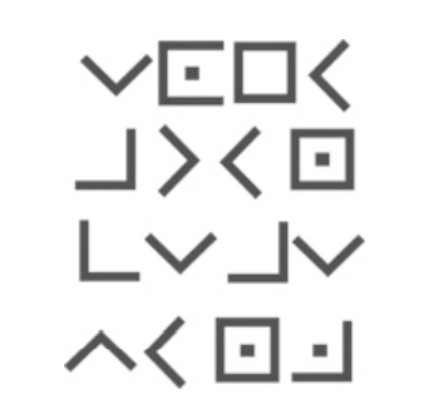
Moreover, Langdon knew, this little pyramid – with its flat top – was not even a true pyramid. Without its tip, this was another symbol entirely. Known as an Unfinished Pyramid, it was a symbolic reminder that man’s ascent to his full human potential was always a work in progress.
DESCRIPTION OF THE PYRAMID
Few minutes after they uncovered the pyramid, Sato tries to take Langdon into custody, due to the small package he was instructed to bring with him. Upon examining the X-ray of Langdon’s bag, Sato and Anderson realize he was carrying the pyramid’s capstone the whole time, unbeknownst even to Langdon himself. His attempts at convincing Sato fall on deaf ears, but before she’s able to arrest him, Warren Bellamy appears and attacks her and Anderson, knocking them unconscious and fleeing with a confused Langdon by his side. Bellamy reveals to him that he’s been contacted by Mal’akh as well and needs Langdon’s help with finding and rescuing Peter.
Then, we learn a bit more about who Mal’akh is. As already mentioned, he infiltrated the Freemasons to get his hands on an ancient source of power, which he believes that Langdon can find for him in return for Peter’s life. Mal’akh’s backstory also gives us more insight into his character – he was a cellmate of Peter’s son Zachary (an entitled, rich kid whose excessive and reckless partying got him into a drug-smuggling business, for which he was arrested and imprisoned in Turkey).
Apparently, his cellmate killed Zachary and managed to get his hands on the boy’s fortune, which he used to flee to Greece under an alias Andros Dareios. Having (allegedly) spoken to Zachary about the Solomons and their connections with Freemasonry, Dareios broke into Peter’s home to find the pyramid but ended up accidentally killing Peter’s mother Isabel. In turn, Peter shot Dareios who fell into a frozen river and miraculously survived. After nursing himself back to health, he covers his scars and entire body with tattoos, adopts the name Mal’akh (old Hebrew for “messenger”; modern Hebrew for “angel”) and begins his quest to become a Mason.
His massive body was shaved and smooth. He lowered his gaze first to his feet, which were tattooed with the scales and talons of a hawk. Above that, his muscular legs were tattooed as carved pillars – his left leg spiraled and his right vertically striated. Boaz and Jachin. His groin and abdomen formed a decorated archway, above which his powerful chest was emblazoned with the double-headed phoenix . . . each head in profile with its visible eye formed by one of Mal’akh’s nipples. His shoulders, neck, face, and shaved head were completely covered with an intricate tapestry of ancient symbols and sigils.
DESCRIPTION OF MAL’AKH’S APPEARANCE
Further into the plot, Mal’akh destroys Katherine Solomon’s entire laboratory, but luckily she escapes and joins Langdon and Bellamy in their quest. However, they’re all later apprehended by Sato’s team and their rescue mission seems to have come to a halt, but Sato allows Langdon and Katherine to confront Mal’akh at his own mansion after they connected the dots surrounding another one of his false identities – Dr. Christopher Abbadon, who appeared to be Peter’s psychiatrist. Their breakthrough is short-lived as Mal’akh ambushes them and kidnaps them as well.
Langdon ends up in an airtight sensory deprivation tank that’s filling up with liquid, and Katherine is tied up to a chair with an open-ended transfusion needle in her arm, but thanks to Sato, agents are able to reach her on time and save her life. After he was interrogated, Langdon appears to have died, and Mal’akh escapes with Peter to the House of the Temple (headquarters of the Scottish Rite. Following his near-death experience, Langdon is seen alive and well, owing it to the fact that the tank’s liquid was breathable and oxygenated. With Sato by his side, he races to the House of Temple where he finds Mal’akh tattooing the last uncovered bit of his skin with “the Word” – a circumpunct – after forcing it out of Peter.
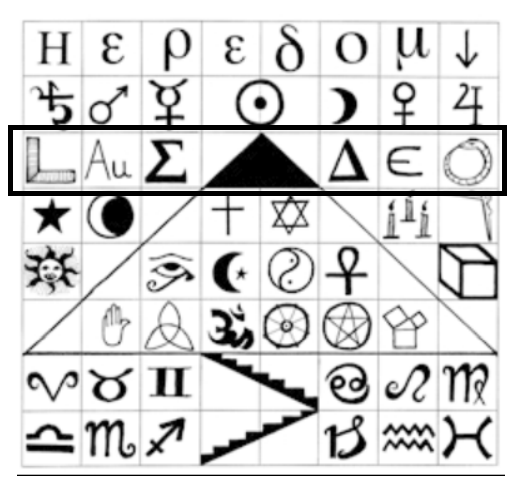
In the idiom of symbology, there was one symbol that reigned supreme above all others. The oldest and most universal, this symbol fused all the ancient traditions in a single solitary image that represented the illumination of the Egyptian sun god, the triumph of alchemical gold, the wisdom of the Philosopher’s Stone, the purity of the Rosicrucian Rose, the moment of Creation, the All, the dominance of the astrological sun, and even the omniscient all-seeing eye that hovered atop the unfinished pyramid.
The circumpunct. The symbol of the Source. The origin of all things.
His last request is for Peter to sacrifice him, so he can fulfill his destiny of becoming a demon and leading the forces of evil. Peter agrees, saying he will do it without hesitation as he wants to avenge his son and mother. In a shocking turn of events, Mal’akh confesses that he is Zachary himself, and that he has faked his death. But, as fate would want it, actual death comes for him shortly after his confession, and his plans of becoming a demonic spirit are thwarted.
In another plot-twist moment, Peter reveals that the circumpunct is not actually the Word. Before elaborating on that, he also informs Katherine that not all of her work is lost, as he has made backups of her research on his own computer. Following up on his earlier revelation, Peter tells Langdon that the Word is none other than the common Christian Bible – the Word of God – and Langdon then realizes that the capstone inscription of the Masonic pyramid has two simple words – Laus Deo (Praise God).
“We’ve lost the Word, and yet its true meaning is still within reach, right before our eyes. It exists in all the enduring texts, from the Bible to the Bhagavad Gita to the Qur’an and beyond. All of these texts are revered upon the altars of Freemasonry because Masons understand what the world seems to have forgotten . . . that each of these texts, in its own way, is quietly whispering the exact same message.” Peter’s voice welled with emotion. “‘Know ye not that ye are gods?’
PETER’S MONOLOGUE ABOUT THE WORD
WHY SHOULD YOU READ THIS?
If you like mysteries, riddles, and history like me, you’ll love this novel. As all of Brown’s novels so far, this one also possesses the usual traits of his writing – a fast-paced story, frequent surprises and unexpected plot twists, and of course, an abundance of mysteries that are always revealed to be connected to the world’s famous buildings, monuments, or literary works in one way or another.
To some people, it may seem that he dumps a lot of info on the reader every few pages, but Brown does so with such cleverness and ease that there’s never a dull moment and you’re kept at the edge of your seat, eagerly anticipating the next big revelation along the novel’s path. To be honest, it is by far my favorite of all Langdon’s adventures.
However, should the exploration of American history turn out to not be your cup of tea, there’s more of Langdon’s trips to be read about: Angels & Demons where he explores the secrets of Vatican; The Da Vinci Code that makes him come to Paris; Inferno where a threat of a deadly virus brings him to Florence and Origin in which he maneuvers the streets of Bilbao. The movie adaptations are an added plus, if not for the plot itself, then for the performance of Tom Hanks as Professor Langdon – if you ask me, he embodied him perfectly.
In any case, I’m sure you’ll find something for yourself. 😉
Sometimes a legend that endures for centuries… endures for a reason.
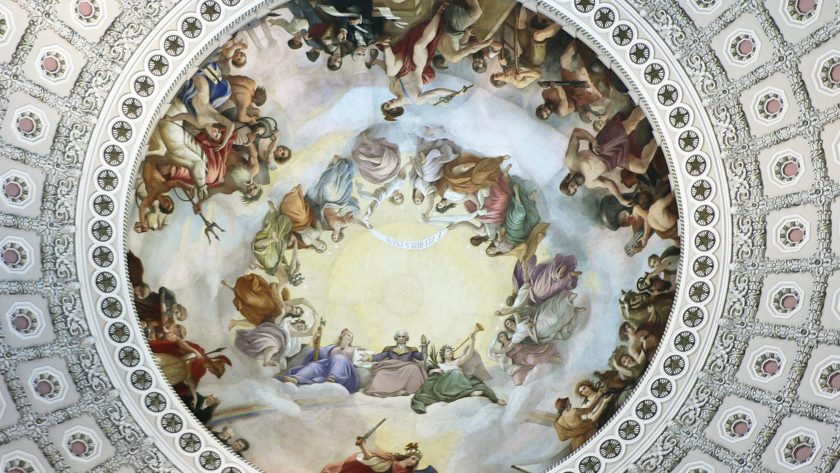
*cover photo is The Apotheosis of Washington – a fresco painted by Greek-Italian artist Constantino Brumidi in 1865, visible through the oculus of the dome in the rotunda of the US Capitol and showing George Washington sitting amongst the heavens, ascending and becoming a god