Pride and Prejudice is a masterpiece, and its famous opening was heard by everyone at least once. Whether you’re in your twenties or your forties, you’ve almost certainly heard of it, either through the original novel or one of the television adaptations. The 2005 film adaptation, in my opinion, was the most authentic to the original material, and thus became my favorite. But, as this is primarily a book blog, let’s do a book review then, shall we?
It is a truth universally acknowledged, that a single man in possession of a good fortune, must be in want of a wife.
pride and prejudice opening
Set in rural England in the early 19th century, this regency novel is considered to be one of the most prominent and loved works ever written, not only among Jane Austen’s other novels but in English literature altogether. Pride and Prejudice tackles the themes of social differences, overcoming various obstacles, and ultimately, achieving love.
WHO ARE THE MAIN CHARACTERS?
At the center of Pride and Prejudice is Elizabeth Bennet, a strong-willed young woman whose mother is hellbent on marrying her daughters in a wealthy family and will not stop at anything to achieve that goal. Elizabeth will only marry on the basis of true love and mutual respect, which always puts her at odds with her mother, who believes she will be alone forever if she maintains that mindset.
I am determined that only the deepest love will induce me into matrimony. So, I shall end an old maid, and teach your ten children to embroider cushions and play their instruments very ill.
ELIZABETH BENNET
Along Elizabeth, we have 4 other Bennet sisters: Jane, Mary, Kitty, and Lydia. They all live in Hertfordshire with their parents – Mr. Bennet, a reasonable gentleman with a dry and sarcastic sense of humor, and Mrs. Bennet, whose main goal in life, as previously stated, is to marry off their five daughters to wealthy men while caring very little about the girls’ happiness.
On the other side, we have Mr. Bingley and Mr. Darcy, who move into the area and rent the Netherfield Park estate, thus becoming the subject of local gossip and by coincidence, the love interests of Elizabeth and Jane.
Other characters who are vital to the plot but aren’t as well-written as the primary characters (in my opinion) are Mr. Collins, a pompous clergyman and a cousin of Mr. Bennet; Mr. Wickham, a militia officer who briefly catches Elizabeth’s heart but turns out to be a treacherous man; and Lady Catherine de Bourgh, the benefactor of Mr. Collins and Mr. Darcy’s aunt.
THE SUMMARY OF PRIDE AND PREJUDICE
At the very beginning of the novel, news of Netherfield Park being rented by Mr. Bingley ring through the neighborhood, and shortly after that, a ball is organized there. Once there, Elizabeth overhears Mr. Darcy and Mr. Bingley talking, including Mr. Darcy mentioning the sentence written in the title of this review. This statement of his sets the first foundations of their mutual dislike. On the other hand, Mr. Bingley finds himself infatuated with Elizabeth’s older sister Jane, and the news of their possible engagement start circling around.
However, as fate would want it, Mr. Darcy suddenly changes and starts realizing that he’s slowly falling for Elizabeth, her being completely unaware of his developing feelings. Not only is she unaware of that, but she also meets Mr. Wickham, the officer who has connections with Mr. Darcy’s family (being the protégé of late Mr. Darcy Sr.) and holds a deep grudge against Mr. Darcy Jr. Already disliking him from their first encounter, Elizabeth’s distaste for him deepens even more.
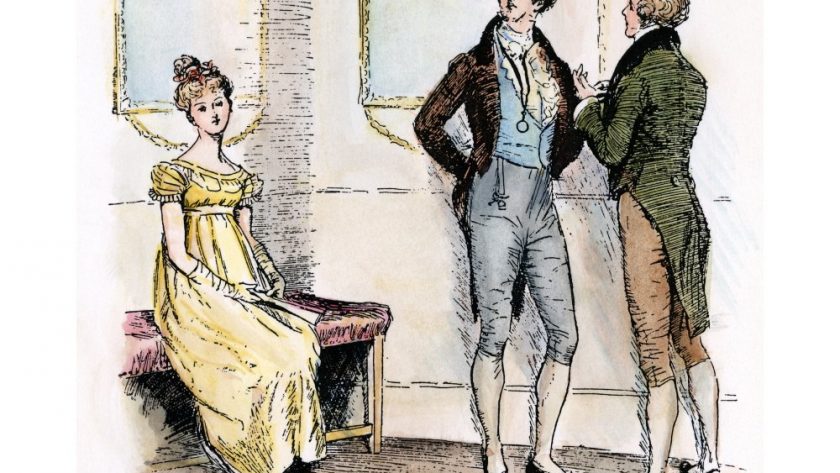
But the attention of every lady was soon caught by a young man, whom they had never seen before, of most gentlemanlike appearance, walking with an officer on the other side of the way.
FEMALE CHARACTERS SEEING MR. WICKHAM FOR THE FIRST TIME
Apart from Mr. Wickham, another man comes into the picture – Mr. Collins. I already mentioned he’s a clergyman and the cousin of Mr. Bennet, but he’s also the reason why Mrs. Bennet wants to marry off her daughters as soon as possible – societal norms at the time required that every estate goes to a male heir, and their Longbourn estate was no exception.
Mr. Collins was a man on a mission; he came to see them with the sole intention of proposing to one of the older Bennet girls (Jane or Elizabeth), but his efforts yielded no results, so he married Elizabeth’s friend Charlotte Lucas instead.
Before the events with Mr. Collins, a second ball took place at Netherfield Park. Elizabeth, though vowing to never dance with Mr. Darcy, somehow found herself accepting his request for dancing with him. Their truce broke when they witnessed her mother and sisters exposing their family to ridicule – the sisters with their ridiculous behavior, and the mother loudly hinting that Jane and Bingley’s marriage is imminent.
Suddenly, Netherfield is vacant, and Mr. Darcy and Mr. Bingley are on their way back to London.
To Elizabeth it appeared, that had her family made an agreement to expose themselves as much as they could during the evening, it would have been impossible for them to play their parts with more spirit, or finer success.
ELIZABETH’S EMBARASSMENT WITH HER FAMILY’S BEHAVIOR
When visiting her friend Charlotte and her husband (Mr. Collins, remember?), Elizabeth finds out the reason for Bingley’s and Darcy’s abrupt departure – Mr. Darcy “saved a friend from an unfavorable match,” and she quickly realized that the “friend” was none other than Bingley.
Elizabeth is appalled, and after Darcy proposes to her shortly after, she furiously rejects him and makes it known that he’s the last man she would ever consider marrying. Later, he gives her a letter explaining why he did what he did, and from this letter she also finds out that Mr. Wickham is not as charming and kind as he presented himself to be.
Fast forward to a few months later, Elizabeth joins her aunt and uncle on a visit to Derbyshire. Among other sites, the also visit Pemberley, which happens to be the estate of Mr. Darcy. He returns unexpectedly and amiably welcomes them to his home, going even as far as introducing them all to his beloved sister Georgiana. Pleasantly surprised by his change of demeanor, Elizabeth enjoys their company, but receives shocking news about her youngest sister Lydia running off with Mr. Wickham.
How little of permanent happiness could belong to a couple who were only brought together because their passions were stronger than their virtue.
QUOTE REFERRING TO LYDIA’S ELOPEMENT WITH WICKHAM
This situation resolved itself rather quickly – Lydia married Wickham, and one of their witnesses was Mr. Darcy. Although he sworn everyone to keep it a secret, big news travel fast, so it didn’t take long for Elizabeth to find out that he was the one who secured the whole match. He didn’t give a second thought to expenses or even to his reputation, leading everyone to believe he had some ulterior motive for having done that, the motive being his love for Elizabeth.
In the end, Netherfield is occupied yet again by, as you’ve probably guessed it, Mr. Bingley and Mr. Darcy. Bingley spares no time and finally proposes to Jane, who accepts it much to her family’s delight. That same day, the Bennets get a visit from Lady Catherine de Bourgh (Mr. Darcy’s aunt), who heard rumors about his proposal to Elizabeth, and demands that she promise never to accept such a thing. Elizabeth refuses and expels Lady Catherine from their home for insulting her family.
Encouraged by the fact that Elizabeth stood up to his aunt, Mr. Darcy visits her and repeats his proposal to her, this time receiving a positive answer. She had difficulties in convincing her father, but he was quick to accept once he learned that she’s marrying for love and not just wealth and position.
The novel’s conclusion is the overview of the three daughters’ marriages, and of course, their mother’s happiness at marrying off more than half of them.
You are too generous to trifle with me. If your feelings are still what they were last April, tell me so at once. My affections and wishes are unchanged; but one word from you will silence me on this subject forever.
DARCY’S SECOND PROPOSAL TO ELIZABETH
WHY SHOULD YOU READ THIS BOOK?
Pride and Prejudice is not your typical rom-com ending with the “and they lived happily ever after” cliché. Yes, the three Bennet girls did get their happy ending, but the book focuses on the journey that led to those marriages and enabled them to even happen. As I mentioned, it deals with social differences, how the main characters got past various difficulties and learned to listen to both their heart and mind, not just one of the two.
The title “Pride and Prejudice” directly relates to Elizabeth and Mr. Darcy, where he is the “pride”, considering that at the beginning of the novel he was haughty and held himself on a pedestal due to his status; Elizabeth, on the other hand, is the “prejudice” – she jumps to conclusions and lacks better judgement, leading her to stubbornly form prejudiced first impressions of people.
One of my favorite things about this book is that throughout the story, they both become aware of their behavioral flaws and learn to work through them, easily seen in the quotes below:
I was spoilt by my parents, who, though good themselves (my father, particularly, all that was benevolent and amiable), allowed, encouraged, almost taught me to be selfish and overbearing; to care for none beyond my own family circle; to think meanly of all the rest of the world; to wish at least to think meanly of their sense and worth compared with my own.
Such I was, from eight to eight and twenty; and such I might still have been but for you, dearest, loveliest Elizabeth! What do I not owe you! You taught me a lesson, hard indeed at first, but most advantageous. By you, I was properly humbled. I came to you without a doubt of my reception. You showed me how insufficient were all my pretensions to please a woman worthy of being pleased.
DARCY TO ELIZABETH
“How despicably I have acted!” she cried; “I, who have prided myself on my discernment! I, who have valued myself on my abilities! who have often disdained the generous candor of my sister and gratified my vanity in useless or blamable mistrust! How humiliating is this discovery! Yet, how just a humiliation!
Had I been in love, I could not have been more wretchedly blind. But vanity, not love, has been my folly. Pleased with the preference of one, and offended by the neglect of the other, on the very beginning of our acquaintance, I have courted prepossession and ignorance, and driven reason away, where either were concerned. Till this moment I never knew myself.
ELIZABETH AFTER READING DARCY’S LETTER
Once you read Pride and Prejudice, it really makes you wonder: do we marry for love, or do we marry for money? Of course, to each their own – every person has their reason for doing something, even marrying, but if you ask me, love should be one of the main conditions. With that in mind, I relate to Elizabeth in a lot of things.
Reading this book helped me realize how quick I was to judge people based on a single aspect of their personality rather than taking the time to learn more about them. Once I let go of that mindset and opened myself up to people, I realized I was missing out on a lot of things, notably friendships.
To conclude – I won’t insist that reading Pride and Prejudice is a must, but you should at least try. Some of you may find it uninteresting or want to throw it across the room because “older” novels aren’t everyone’s cup of tea. Those of you who decide to give it a go and read it will not be disappointed.
The distance is nothing when one has a motive.